Best Body Composition Scales for Muscle Mass Tracking in 2026: FITINDEX, Arboleaf & GE Reviewed
June 24, 2026 · 10 min read
Let me be honest with you. I used to step on the scale every morning, stare at the number, and feel either great or terrible about my day — based on nothing more than gravity and whatever I had for dinner the night before.
It took me an embarrassingly long time to realize that the number on a regular bathroom scale tells you almost nothing useful. It doesn't tell you if you're building muscle. It doesn't tell you if you're losing fat or just water. It doesn't explain why your jeans fit better even though your weight has gone up.
That's when I started looking into body composition scales — and honestly, once you start tracking muscle mass, body fat percentage, and visceral fat separately, you can't go back to just weighing yourself.
In 2026, the best options on Amazon have gotten genuinely impressive. This article focuses on the top three 8-electrode models I'd actually recommend: FITINDEX, Arboleaf, and GE Smart Scale with handle.
Each one takes a slightly different approach, and the right choice really depends on what you're trying to track.
First Things First: What Makes a Body Composition Scale Worth It?
A smart body composition scale works by sending a tiny, harmless electrical signal through your body. The signal travels differently through fat, muscle, bone, and water — and from that, the scale calculates a full breakdown of what your body is actually made of.
We're talking metrics like:
- Muscle mass — total and, with better models, broken down by body part
- Body fat percentage
- Visceral fat — the kind that wraps around your organs, the one worth watching
- Bone mass
- Body water percentage
- BMI and metabolic age
Now, here's the thing most people don't know: not all smart scales are equal, even if they look similar in photos. The big difference is in the number of electrodes. Cheap scales use 4 electrodes, all under your feet — so they measure your legs and estimate the rest of your body. An 8-electrode scale adds sensors at the hand level too, giving it a complete circuit from hands to feet. That means your arms and torso get measured directly, not guessed.
That's the difference between data you can actually trust and data that's just… a number.
Best Overall · Muscle Tracking
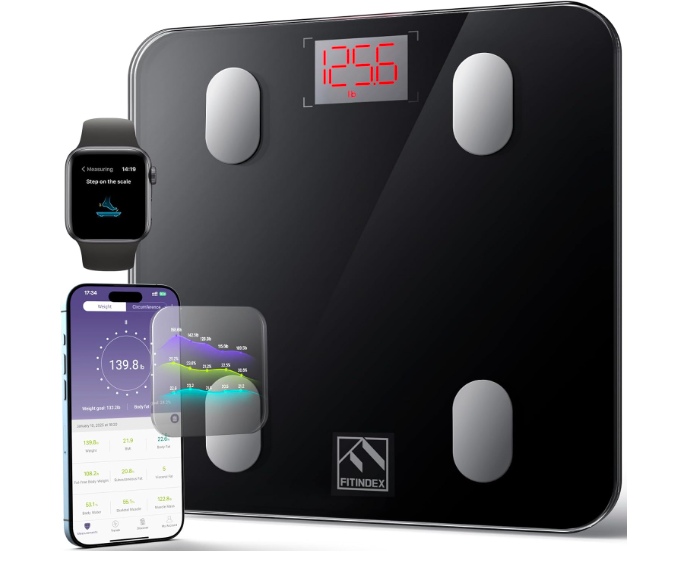
1. FITINDEX Smart Scale — Best Overall for Muscle Mass Tracking
8 electrodes · Dual-frequency BIA · 50+ metrics · Segmental muscle analysis · Bluetooth · 400 lb · Apple Health, Samsung Health, Fitbit, MyFitnessPal
I'll start with FITINDEX because it does something I genuinely didn't expect to find in a home scale at this price point: it breaks down your muscle mass by body part.
Most scales give you one number — total muscle mass. FITINDEX gives you five: left arm, right arm, trunk, left leg, right leg. That might sound like overkill until the day you realize your left arm is consistently weaker than your right, or that your lower body is doing all the work while your core barely registers. For anyone doing strength training, that's actually really useful information.
The technology behind this is called dual-frequency BIA — it sends two electrical signals at different frequencies through your body instead of one. The result is a cleaner separation between fat tissue and lean muscle. In plain terms, the readings are more accurate and more consistent over time.
You also get 50+ metrics per scan — skeletal muscle mass, subcutaneous fat, visceral fat, protein levels, bone mass, metabolic age — all visible in the FITINDEX app. Weekly and monthly trend charts, CSV export, and sync with Apple Health, Samsung Health, Google Fit, and Apple Watch.
One small heads up: keep your feet dry and hold the handles correctly. BIA is sensitive to posture and moisture.
Bottom line: If muscle tracking is your main goal — especially if you want to know which muscles are growing — FITINDEX is the one to get.
Daily Use · No Phone Needed
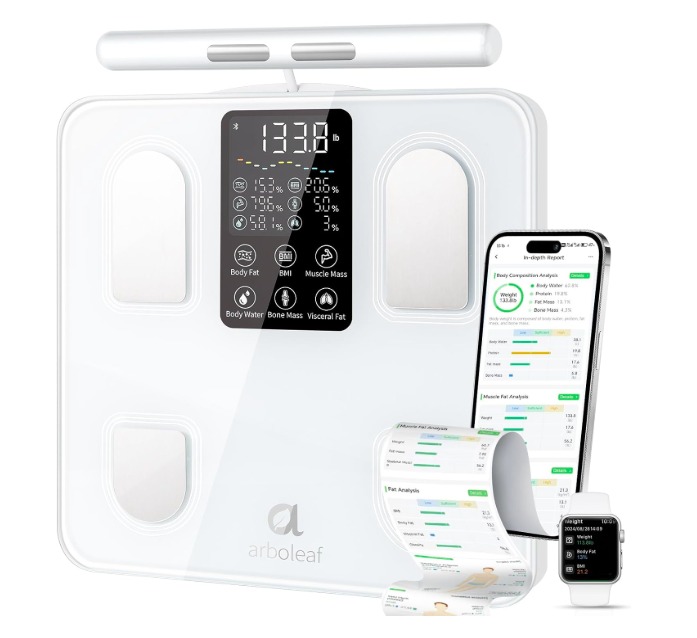
2. Arboleaf Dual-Frequency Scale — Best for Consistent, Phone-Free Readings
8 electrodes · Dual-frequency BIA · 14–50+ metrics · On-scale display · Bluetooth · 400 lb · Apple Health, Google Fit
Here's something that sounds small but makes a real difference in daily life: the Arboleaf shows your key metrics directly on the scale's screen. No fumbling for your phone at 6am. No waiting for an app to sync. You step on, you see your weight, body fat, and muscle mass, and you move on with your morning.
Like FITINDEX, the Arboleaf uses dual-frequency BIA — two signals at different frequencies for more accurate fat-versus-muscle separation. Even if you drank more water last night or you're slightly dehydrated, the readings stay relatively stable. That consistency is what makes it useful week over week.
It doesn't do segmental muscle analysis the way FITINDEX does — no left-arm vs right-arm breakdown here. But for most people who want to know "am I building muscle and losing fat over time?", it delivers exactly what you need in a clean, easy-to-use package.
The app is simple and clear. Charts, trends, compatibility with Apple Health and Google Fit. Nothing complicated.
Bottom line: The Arboleaf is the scale I'd recommend to someone who wants reliable body composition data without making it a whole thing every morning.
Upper Body Tracking · InBody-Style
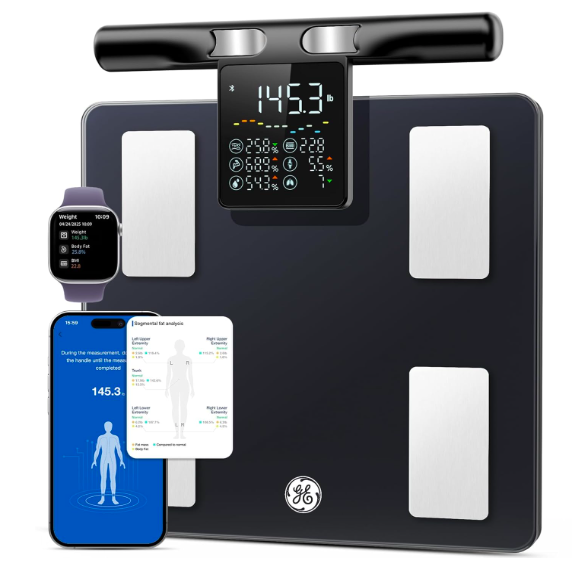
3. GE Smart Scale with Handle — Best for Tracking Upper Body Muscle
8 electrodes (4 foot + 4 in handle) · 50 metrics · Bluetooth · Large display · 400 lb · Apple Health, Google Fit
This one is a little different — and if you're specifically trying to see whether your arms, shoulders, or chest are responding to your workouts, it's worth paying attention to.
Most 8-electrode scales still place all four hand sensors inside the platform under your feet, using algorithms to estimate your upper body. The GE scale adds a physical handle with four electrodes that you actually grip while standing on the scale. You're holding the device with both hands, feet on the platform — and suddenly the circuit is genuinely running from your hands through your core and down to your feet.
That's a fundamentally more complete measurement. It's the closest thing to a professional InBody-style reading you'll find on Amazon without spending hundreds more.
If you're a beginner in strength training who wants to see evidence that your upper body workouts are working — not just feel it, but see it in the data — this scale gives you that in a way flat platform models simply can't.
The trade-off is size. The handle mechanism makes the GE scale slightly bulkier than a standard flat scale. If accurate upper body composition data is what you're after, that's a fair exchange.
Bottom line: Get the GE scale if upper body muscle tracking is a priority and you want the most direct measurement available at this price point.
How to Pick the Right One for You
| What you want | Best choice |
|---|---|
| See muscle gains per body part (left vs right) | FITINDEX |
| Quick readings without touching your phone | Arboleaf |
| Track whether upper body workouts are actually working | GE with handle |
| Multiple people in one household | FITINDEX (30+ profiles) |
A Few Tips to Actually Get Good Readings
No matter which scale you choose, the technology only works well if you're consistent. Here's what actually makes a difference:
- Weigh yourself at the same time each day — morning is best, before eating or drinking. Hydration shifts throughout the day and affects BIA more than most people realize.
- Stand barefoot on dry feet. Even a small amount of moisture throws off the electrical signal.
- Don't weigh yourself right after a hard workout. Post-exercise readings can look completely different from your baseline.
- Focus on weekly trends, not daily numbers. Day-to-day variation is normal and mostly meaningless.
The Bottom Line
If you've been chasing a number on a regular scale, it's time to stop. Weight alone is one of the least useful fitness metrics there is. Muscle mass, body fat percentage, visceral fat — these are the numbers that actually tell you something.
All three scales in this review — FITINDEX, Arboleaf, and GE — give you that fuller picture. They're different tools for different needs, but any one of them is a genuine upgrade over a standard bathroom scale.
Step on. Get the data. Train with something real to show for it.
Frequently asked questions
Disclaimer: Body composition scales use estimates based on BIA technology. Results can vary based on hydration, posture, and individual factors. Always consult a healthcare professional for clinical-grade body composition assessment.
This article contains affiliate links. If you purchase through them, we may earn a small commission at no extra cost to you.