I Added a Grounding Mat to My Evening Routine. Here's What Happened.
June 4, 2026 · 7 min read
I'll be honest. When I first heard about grounding mats, I rolled my eyes a little.
Connecting to the Earth's electrons through a mat plugged into a wall outlet? Sounded like wellness theater.
Then I started reading the actual research. And I changed my mind — carefully, with caveats.
What Is Grounding, Actually?
Grounding — also called earthing — is the practice of making direct physical contact with the Earth's surface.
When you walk barefoot on grass or sand, your body absorbs free electrons from the Earth. The Earth's surface is electrically conductive and maintains a negative potential — a constant, essentially unlimited supply of free electrons.
The problem? Most of us never touch the ground anymore. Rubber-soled shoes, apartments, office chairs. We're electrically disconnected almost all the time.
A grounding mat is designed to replicate that connection indoors. It plugs into the grounding port of a standard outlet — not the live current, just the ground — and conducts electrons to your body through direct skin contact.
Simple idea. But does it actually work?
What the Research Says
I want to be clear here. The science is real but still emerging. This is not a supplement backed by decades of randomized controlled trials.
That said, it's more than just anecdote.
Sleep and stress
A randomized, double-blind, placebo-controlled study found that earthing is beneficial for improving stress, insomnia severity, and daytime sleepiness — increasing sleep time and providing preliminary evidence for improved sleep quality.
Recovery and inflammation
A 2019 study found that participants who slept on a grounding mat after intense exercise reported feeling less sore and showed lower blood inflammation levels compared to those who were ungrounded.
An honest summary: grounding has modest but real evidence for reducing inflammatory markers, improving subjective sleep quality, and normalizing cortisol rhythms over a multi-week window. It's closer in evidence tier to omega-3 supplementation or magnesium before bed than to CPAP or SSRIs — probably beneficial for many, not a substitute for medical treatment.
That last comparison is what convinced me to try it.
The Mat I Use
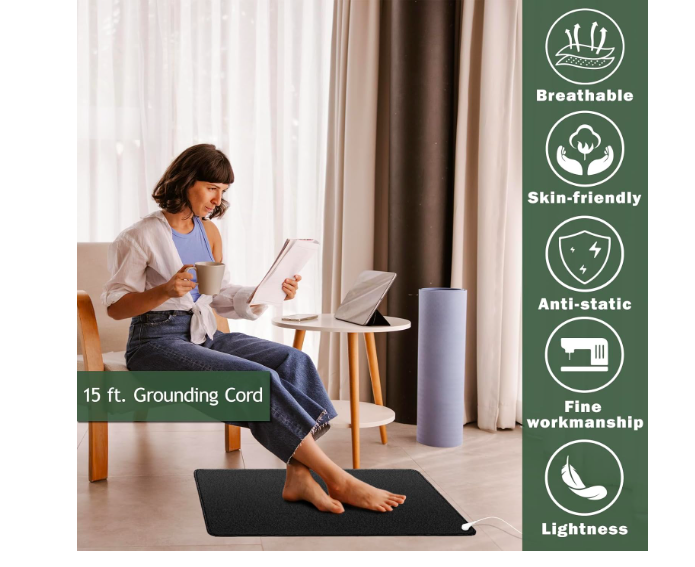
This is the NIULAFR Grounding Mat 35.4 × 23.6 inches — large enough to use under your feet while you work, or on the floor during an evening wind-down.
It comes with a 15 ft cord that connects to the grounding port of a standard outlet. No batteries, no charging, no app. Just plug in and sit or stand on it barefoot.
The size is practical. I use mine on the floor while I do my evening reading. Feet flat on the mat, barefoot, for 30–45 minutes before bed.
Why I Pair It With Magnesium and Omega-3
This is where the evening stack comes together.
All three work on the same systems — inflammation, nervous system regulation, and sleep quality — from different angles.
Magnesium glycinate relaxes muscles and calms the nervous system. It's the supplement I reach for every single evening.
Omega-3 works on inflammation from the inside. Together with magnesium it enhances recovery and physical performance.
Grounding adds the third layer — the environmental input. Earthing shifts the nervous system from a sympathetic to a parasympathetic state, allowing the body to return to a normal state of electrical balance.
My evening stack, exactly
- 6:00 PM — Omega-3 with dinner
- 9:00 PM — Magnesium glycinate
- 9:00–9:45 PM — Feet on the grounding mat while reading
- 10:00 PM — Sleep
What I Actually Noticed
Week one: nothing dramatic. I wasn't expecting anything dramatic.
Week two: I started falling asleep faster. Not a huge difference, but noticeable. The usual mental chatter before sleep was quieter.
Week three: my legs felt less restless in the evenings. That low-level tension I sometimes carry from sitting all day — it eased faster when I used the mat.
I can't prove causation. But adding the mat to the mix noticeably improved the evenings for me.
Honest Limitations
The research is promising but small-scale. Most studies have limited sample sizes. A grounding mat is not a cure-all and does not replace exercise or a healthy diet.
For the mat to work, you need skin contact. Socks with rubber or synthetic fibers insulate. Use your grounding mat barefoot, or with socks made from natural materials like cotton or bamboo.
Results also vary by person. Approach it as an experiment, not a guarantee.
Who This Is For
- You have trouble winding down in the evenings
- You sit most of the day indoors and rarely go barefoot outside
- You're already using magnesium or omega-3 and want to add a non-supplement layer
- You want to try grounding without spending $100+ on a premium mat
Bottom Line
The NIULAFR Grounding Mat is a low-cost, low-risk way to experiment with earthing at home. Under $25. No setup complexity. No ongoing cost.
The science isn't conclusive. But it's more solid than I expected — and the practical experience, combined with magnesium and omega-3, made a real difference to my evenings.
Worth trying. Especially at this price.
NIULAFR Grounding Mat 35.4 × 23.6 in
15 ft grounding cord, breathable conductive surface, no batteries required.
Check on AmazonAffiliate disclosure: links may earn a small commission at no extra cost to you. I only recommend products I personally use.