La Roche-Posay Mela B3 Serum: The Dark Spot Treatment With a Brand-New Ingredient
June 8, 2026 · 8 min read
Check the price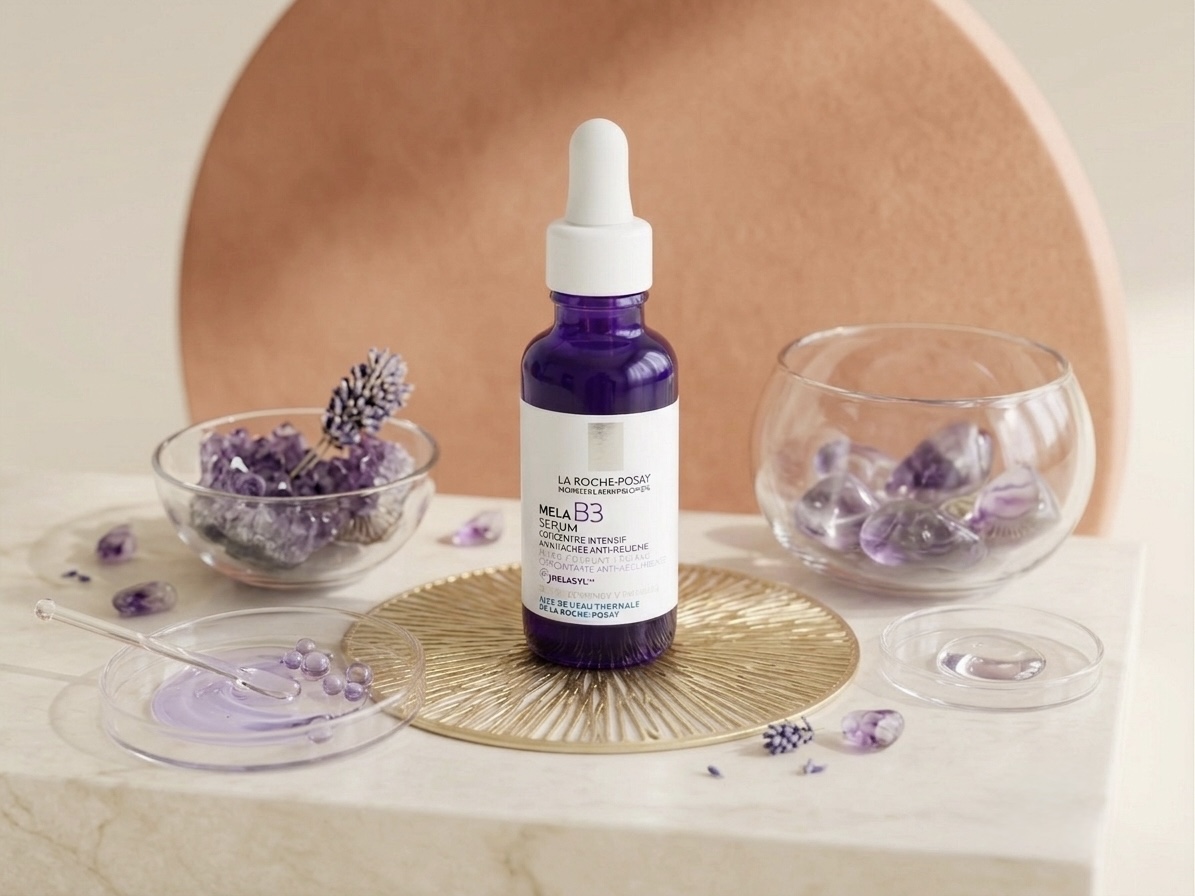
Dark spots are one of the most frustrating skin concerns to deal with. You clear a breakout, and the mark stays for months. You wear SPF religiously, and the sun spots from three summers ago are still there. Most brightening serums help a little — but very few actually address persistent hyperpigmentation in a meaningful way.
That's exactly why the La Roche-Posay Mela B3 Serum caught my attention.
It's not another vitamin C formula. It's not just niacinamide repackaged. It contains a patented ingredient that works differently from anything I'd seen before — and the clinical results are hard to ignore.
Here's everything you need to know.
What Is the La Roche-Posay Mela B3 Serum?
The Mela B3 is an anti-hyperpigmentation face serum designed specifically to reduce dark spots, uneven skin tone, and discoloration. It comes in a 30ml dropper bottle with a lightweight gel-serum texture that absorbs fast and doesn't feel heavy under moisturizer or SPF.
It was co-developed with dermatologists and is suitable for all skin types and tones, including sensitive skin. That's not something you can say about every brightening serum on the market.
The Key Ingredients — And Why They Matter
Melasyl™ — the ingredient that makes this serum different
Melasyl is the star of this formula. It's a brand-new, multi-patented molecule exclusive to La Roche-Posay, and it works by inhibiting melanin synthesis through a new mode of action — targeting precursors of melanin rather than melanin itself.
What does that mean in practice? Most dark spot treatments work after pigmentation has already formed. Melasyl works earlier in the process. It intercepts excess melanin precursors, preventing the overproduction of melanin and the formation of new dark spots in the first place. It's a preventative and corrective approach at the same time.
This ingredient is the result of 18 years of research, which explains why it took this long to arrive.
10% Niacinamide — the dark spot staple, at a real concentration
Niacinamide (vitamin B3) is well-established for fading pigmentation. At 10%, this concentration actually does something. While Melasyl works upstream to prevent new spots from forming, niacinamide works to fade existing pigmentation and prevent future discoloration — so the two ingredients are genuinely complementary.
Supporting ingredients
The formula also includes retinyl palmitate, hyaluronic acid, and LHA, which support skin surface renewal and hydration for a more radiant complexion. It's alcohol-free, fragrance-free, and non-comedogenic — which matters a lot if you're treating post-acne marks and want to avoid triggering new breakouts.
What It Targets
The serum can be used to treat visible discoloration, dark spots, age spots, sun spots, and post-acne marks (post-inflammatory hyperpigmentation), as well as uneven skin tone, dullness, and lack of radiance.
This breadth matters. PIH from acne behaves differently from UV-induced sun spots. A formula that addresses both — through different mechanisms — is genuinely more useful than a single-target approach.
Does It Actually Work? What the Studies Say
I always look at the clinical data before recommending anything.
In a study of 50 subjects, dark spots were clinically reduced for 94% of participants after 12 weeks, based on instrumental measurement of the overall area of dark spots.
After 8 weeks, 90% of subjects showed improvement in at least one of: the size and contrast of a persistent dark spot, or the density of dark spots overall — assessed by expert grading.
These are dermatologist-assessed measurements, not self-reported impressions. That's a meaningful distinction. The formula was also developed based on research involving 23,000 people and is proven across all skin tones — important if you have medium or deeper skin, since many brightening actives have historically been tested primarily on lighter phototypes.
How to Use It
Apply 3–4 drops to the face, neck, and décolleté after cleansing, morning and evening. Always finish your morning routine with daily SPF.
That last point is non-negotiable. If you're treating hyperpigmentation and skipping sunscreen, you're undoing the work. New melanin production triggered by UV exposure will outpace what any serum can correct.
Who Is This Serum For?
This makes sense for you if:
- You have stubborn dark spots that haven't responded to vitamin C or basic brightening serums
- You're dealing with post-acne marks (PIH) that linger long after breakouts clear
- You want a dermatologist-grade dark spot corrector without a prescription
- You have sensitive skin and need an alcohol-free, fragrance-free formula
- You're looking for a face serum that works on both existing discoloration and prevents new spots from forming
My Honest Take
Most dark spot serums I've tried are variations on the same formula — vitamin C, kojic acid, maybe arbutin. They work to a point. What they rarely do is stop pigmentation from coming back.
Melasyl changes that logic. The fact that it works at the melanin precursor stage — before discoloration has a chance to form — is what makes this serum genuinely different from everything else in this category. And pairing it with 10% niacinamide means you're also actively fading what's already there.
It's not an overnight fix. You're looking at 8–12 weeks to see meaningful results. But for anyone dealing with persistent hyperpigmentation — the kind that sticks around no matter what you try — this is one of the most science-backed options currently available without a prescription.
Worth it.
Shop the Mela B3 Serum on LookfantasticFrequently asked questions
Affiliate disclosure: links may earn a small commission at no extra cost to you. I only recommend products I genuinely think are worth considering.