Most sleep wearables explain the night after it is over. DUVA ONE is built to act while it is still happening.
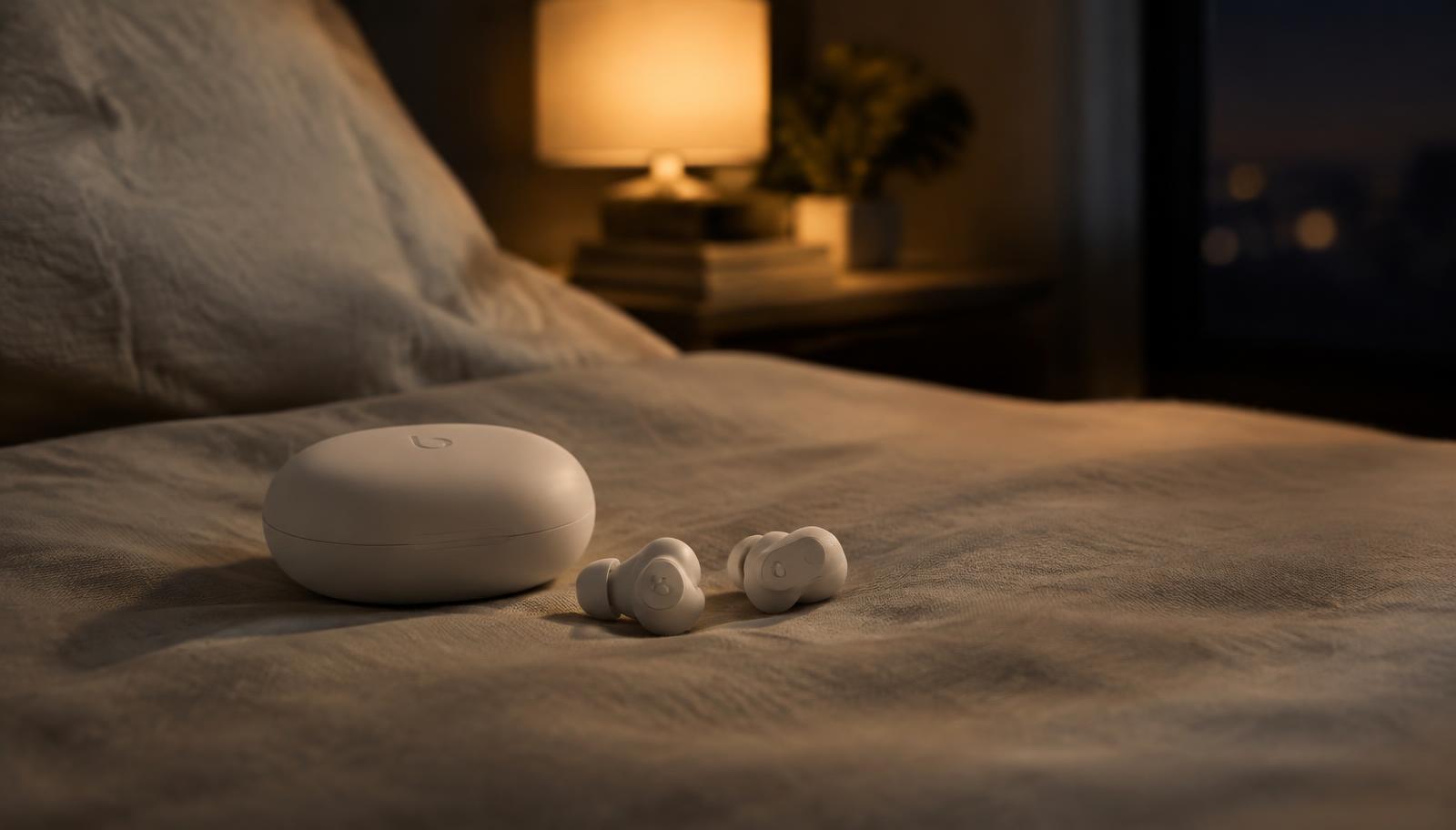
It is an in-ear sleep system with three parts: low-profile earbuds, a charging case that senses the bedroom, and an app that ties everything together. DUVA, a brand from Fitnexa, introduced it at IFA 2026. This guide covers what it does, when it is planned to arrive, and what is still unknown.
DUVA ONE at a Glance
| Spec | Details |
|---|---|
| Type | In-ear sleep system (earbuds, sensing case, app) |
| Brand | DUVA, created by Fitnexa |
| Announced | IFA 2026 |
| Release | Planned for October 2026 |
| Noise reduction | Up to 42 dB (passive isolation, hybrid ANC and sleep audio combined) |
| Sensors | In-ear PPG and motion sensors; the case senses noise, light, temperature and humidity |
| Battery | Up to 16 hours in the most efficient setup; 9.5 hours with ANC on |
| Case | USB-C and wireless charging, up to five extra recharges |
| Earbuds | Around 3.3 g each, around 9.9 mm low-profile design |
DUVA ONE release date
DUVA ONE is planned for release in October 2026. The announcement does not give an exact day. Plans can shift, especially before launch. This page will be updated as soon as a firm date is confirmed.
How DUVA ONE works
The company describes a typical night like this. The evening starts with a podcast over Bluetooth. Once the wearer falls asleep, the system can switch to locally stored sleep audio and save power.
If a partner starts snoring or traffic gets louder, it can adjust the noise cancellation or add sound masking. In the morning, a private offline alarm wakes only the wearer. No active phone connection is needed.
An AI agent decides what to do. It reads the sleep and room signals, the playback status and the wearer's own preferences. The app lets users control sleep audio, playback time, ANC strategy and nighttime interventions. All of this is the maker's description — real-world performance has not been independently tested yet.
Noise control
DUVA ONE layers three things: passive isolation, hybrid ANC and sleep audio. Together they are rated for up to 42 dB of noise reduction. There is also a Transparency Mode and adaptive ANC calibration. "Up to" is the key phrase — that figure is a best-case number, not a promise for every bedroom.
Sleep tracking and room sensing
The in-ear PPG and motion sensors estimate sleep stages. They also track heart rate, HRV, sleep position and movement. The charging case adds the room to the picture, monitoring noise, light, temperature and humidity.
Sleep stage data from wearables is an estimate. It is useful for spotting trends, not for medical conclusions.
Sleep guidance and alarm
The AI also generates personalized audio guidance based on the wearer's real-time sleep state. The aim is to help the wearer drift off gradually. The private alarm rises in volume step by step, and snooze options of 5, 10 or 15 minutes are controlled from the earbuds.
Battery life
DUVA ONE is rated for up to 16 hours in its most efficient setup. That includes 13 hours of local audio with ANC off. With ANC on, the rating drops to 9.5 hours. The case supports up to five additional recharges through USB-C or wireless charging.
Comfort and privacy
Each earbud weighs around 3.3 g and measures around 9.9 mm. The low-profile shape is designed with side sleepers in mind. Comfort is personal, though, and real reviews will say more. On privacy, Fitnexa states that the device does not store ambient audio or record conversations.
Who might like it
- Light sleepers who are bothered by snoring or street noise
- Anyone who wants sleep audio, noise control and sleep tracking in one system
- Anyone who likes an alarm that wakes only them
Who may want to wait? Anyone who needs independent proof of comfort, noise reduction and sleep-tracking accuracy before buying.
What is still unknown
- The exact release day
- Independent tests of the real-world noise reduction
- How accurate the sleep-stage estimates are
- How comfortable the earbuds feel across a full night
- How well the app and the AI responses work in daily use
How it compares
Sleep-focused wearables are crowding in from every direction. The Soundcore SleepLab Pro takes a similar in-ear route, while the Garmin Index Sleep Monitor and screenless bands like the Actxa Spark Band stay on the arm or wrist. Our screenless tracker guide covers what you can buy today.
DUVA ONE vs Other Sleep Trackers
| Spec | DUVA ONE | Soundcore SleepLab Pro | Garmin Index Sleep Monitor |
|---|---|---|---|
| Format | Low-profile sleep earbuds | Contactless nightstand device | Soft upper-arm sleep band |
| Core features | Adaptive ANC, sleep audio, private alarm and sleep tracking | Radar sleep tracking, sound, ambient light and adaptive sleep program | Sleep stages, HRV, SpO2, skin temperature and Garmin recovery data |
| Battery | Up to 16 hours; 9.5 hours with ANC | Mains-powered nightstand device | Up to 7 nights |
| Design | In-ear; about 3.3 g per earbud | Nothing to wear; sits beside the bed | Screenless fabric band worn on the upper arm |
| Pricing | Not confirmed before launch | Not confirmed before launch | Established retail product; price varies by market |
| Ideal use | Blocking noise while listening and tracking sleep | Tracking sleep without wearing a device | Garmin users wanting detailed overnight recovery data |
DUVA ONE and SleepLab Pro pricing and real-world performance remain unconfirmed before launch.
Bottom line
DUVA ONE tries something different: a sleep system that reacts during the night instead of reporting on it afterwards. The idea is strong. The proof will come from independent testing once it launches.
This article is for general information only and is not medical advice.
Frequently asked questions
Gadgets · September 18, 2026
Actxa Spark Band: Release Date, Features & Glucose Estimate
wearablesleeprecoveryReadGadgets · September 23, 2026
Apple Screenless Fitness Tracker: Release Date & Features
wearablerecoverysleepReadGadgets · September 21, 2026
Sekonda Smart Ring: Features, Battery Life and Who It's For
wearablesleeprecoveryReadGadgets · September 8, 2026
Best Fitness Trackers Without a Subscription (2026)
wearablesleeprecoveryRead